Farleys.ca
The Farley Family of Wolverhampton
The Farley Family of Wolverhampton
The Wikepedia article, Coat of Arms gives the following explanation:
In the heraldic traditions of England and Scotland, an individual, rather than a family, had a coat of arms.
In those traditions coats of arms are legal property transmitted from father to son; wives and daughters could also bear arms modified to indicate their relation to the current holder of the arms.
Undifferenced arms are used only by one person at any given time.
Other descendants of the original bearer could bear the ancestral arms only with some difference: usually a colour change or the addition of a distinguishing charge.
One such charge is the label, which in British usage (outside the Royal Family) is now always the mark of an heir apparent or (in Scotland) an heir presumptive.
Because of their importance in identification, particularly in seals on legal documents, the use of arms was strictly regulated; few countries continue in this today.
This regulation has been carried out by heralds and the study of coats of arms is therefore called "heraldry".
In time, the use of arms spread from military entities to educational institutes, and other establishments.
Some nations, such as England and Scotland, still maintain the same heraldic authorities which have traditionally granted and regulated arms for centuries and continue to do so in the present day.
In England, for example, the granting of arms is and has been controlled by the College of Arms.
Unlike seals and other general emblems, heraldic "achievements" have a formal description called a blazon, which uses vocabulary that allows for consistency in heraldic depictions.
A coat of arms is a heraldic visual design on an escutcheon (i.e., shield), surcoat, or tabard.
The coat of arms on an escutcheon forms the central element of the full heraldic achievement, which in its whole consists of a shield, supporters, a crest, and a motto.
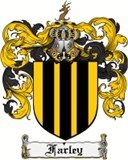
An early Coat of Arms, granted to a family named Farley, is:
|
Three black pales on a gold shield |
Brooke-Little (p. 155) and Pastoureau (p. 129) explain that a "pale" is a broad vertical band.
A crest, granted to a family named Farley, is:
 |
an antelope's head erased and |
A different crest, granted to a family named Farley, in Surrey, is:
 |
on a mount vert, in front of a Calvary cross gu., |
These crests are described in Fairbairn's first volume, p. 195, and illustrated in his second volume in plates 127.1 and 130.5, respectively.
Brooke-Little (p. 92) and Pastoureau (p. 125) explain that "erased" means torn off roughly leaving a jagged edge.
Brooke-Little (p. 170) and Pastoureau (p. 130) explain that the abbreviation, "ppr", stands for "proper", which means that a charge (pictorial element) is shown in its natural colour.
Brooke-Little (p. 216) and Pastoureau (p. 131) explain that "vert" is the tincture (colour) green.
Brooke-Little (p. 110) and Pastoureau (p. 127) explain that "gu.", is the abbrviation for "gules", which is the tincture (colour) red (pure vermilion).
Brooke-Little (p. 158) and Pastoureau (p. 129) explain that "passant" means a quadraped shown horizontally, in profile and walking, with the right front paw raised.
"Tollit peccata mundi" can be translated as "takes away the sins of the world".
The Wikipedia article, Lamb of God, says that "Agnus Dei . . . is a title for Jesus that appears in the Gospel . . . at John 1:29, where John the Baptist sees Jesus and exclaims, "Behold the Lamb of God who takes away the sin of the world." It appears again in John 1:36."
| References: |
| Brooke-Little, J. P., An Heraldic Alphabet. New and Revised Edition. (Robson Books Ltd.; London, 1996). |
| Fairbairn, James, Fairbairn's book of crests of the families of Great Britain and Ireland. Fourth Edition, Revised and Enlarged, in Two Volumes (T. C. and E. C. Jack; London, 1905). |
| Pastoureau, Michel, Heraldry: An Introduction to a Noble Tradition. Translated from the French by Francisca Garvie (Harry N. Abrams, Inc; New York, 1997). |
Last Updated: 2025-09-05
Webmaster
© copyright 2022: farleys.ca