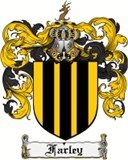
Farley - a descriptive word, a place-name and a surname
The word "farley" has Old English origins. In Anglo-Saxon, fearn means "fern" and leah means "piece of ground" and fearnlæs means "fern-pasture".1 So, farley (or farleigh) can mean "a fern-covered clearing".
The descriptive word became a place name when "Farley" was used to identify a specific location.2 There are still towns, villages, parishes, or farmsteads in several counties, including Berkshire, Derbyshire, Hampshire, and Staffordshire, called Farley, or Farleigh (see below).
This toponym (place-name) became a family name when it was used to identify the location of someone's birth place. So, for example, when someone moved to a new place in search of work, they might be given the surname, Farley, to indicate whence they had come. Surnames such as this are called habitational surnames.
It is important to know that our English surname "Farley" is not at all connected to the Irish "Farley".
Edward MacLysaght, in his entry on (O)FARRELLY, Farley3 says:
- O'Farrelly — O Faircheallaigh in Irish — is the name of a Breffny sept4 associated in both early and modern times principally with Counties Cavan and Meath. Their leading family were erenaghs of Drumlane, Co. Cavan, and were also coarbs5 of St. Mogue until the suppression of the monasteries in the sixteenth century. The Gaelic poet Feardorcha O’Farrelly (d. 1746) was born in Co. Cavan.
- The O'Farrelly sept seated at Knockainy, Co. Limerick, mentioned as such by O'Heerin in his fourteenth century "Topographical Poem" and still numerous in Co. Limerick when the 1659 census was compiled are no longer to be found there: even a century ago O'Donovan commented on the fact that they had disappeared.
- In parts of Ulster Farley is used as a synonym of Farrelly, which leads to confusion since Farley is a common English name. Cardinal Farley (1842-1918), Archbishop of New York, who was born in Co. Armagh, is an example of the use of this synonym.
Current English places called Farley or Farleigh
- Farley is a township in Pontesbury parish, Shropshire, 1½ mile NW of Pontesbury.
- Farley is located in the county of Shropshire, West Midlands, two miles north-east of the town of Much Wenlock, five miles south-west of the major town of Telford, 83 miles north of Cardiff, and 128 miles north-west of London.
- Farley is a hamlet and civil parish in the Staffordshire Moorlands district, in the English county of Staffordshire. It is near to the villages of Alton and Oakamoor.
- Farley is a village in southeast Wiltshire, England, about 5 miles east of Salisbury.
- Farley Hill is a council housing estate in Luton, Bedfordshire.
- Farley Mount is a hill and one of the highest points in Hampshire. It is located within Farley Mount Country Park, situated about four miles west of the historic city of Winchester, Hampshire.
- Farleigh is a village in the civil parish of Chelsham and Farleigh in the Tandridge District of Surrey.
- Farleigh Hungerford Castle, sometimes called Farleigh Castle or Farley Castle, is a medieval castle in Farleigh Hungerford, Somerset.
- East Farleigh is a village and civil parish in the local government district of Maidstone, Kent and
West Farleigh is a village and civil parish four miles (6 km) southwest of Maidstone in the county of Kent.
Earliest Spellings
- Name Origin Research 1980 - 2017 says:
- Farley Hill in Berkshire was first recorded as "Farellei" in the Domesday Book of 1086; the place in Derbyshire was first recorded as "Farleie" in the Domesday Book; and the place in Hampshire was first recorded as "Ferlege", also in the Domesday Book. Farley in Staffordshire was first recorded as "Fernelege" in the Domesday Book of the county, and as "Farleye" in "Inquisitiones post mortem", dated 1273.
Early examples of the surname include Richard de Farlegh (1222, Oxford), and John Farleye (1332, Worcestershire).
One Thomas Farley, and his wife Jane, were recorded in a Muster of the Inhabitants of Virginia in January 1624; they had arrived on the "Ann" in 1623.
The first recorded spelling of the family name is shown to be that of William de Ferlecheia, which was dated 1189, in "Medieval Records of Glastonbury Abbey", Somerset, during the reign of King Henry 11, known as "The Builder of Churches", 1154 - 1189.
- P. H. Reaney, A Dictionary of English Surnames, p. 163, gives similar instances of the earliest recorded spellings of "Farley, Farleigh" and "Farlow, Varlow, Fairlaw".
- © Paul Maloney, Mississauga, Ontario, 2021.
1J.R. Clark Hall, A Concise Anglo-Saxon Dictionary, pp. 112, 213, 112.
2Some have suggested that the place-name, Farley, is derived from fair meaning "beautiful" and leah meaning "woodland".
3Edward MacLysaght, Irish Families: Their Names, Arms and Origins, pp. 84-85.
4Ibid., p. 9, explains that "sept" is a collective term for those connected by a comon surname and locality.
5Ibid. "Erenagh" (Irish, aircinnech) means "head" and "coarb" (Irish, comarba) means "heir". Originally, the abbot of a church would be the "heir" of the saintly founder or the "head" of an associated place. Later in history, these terms could refer to a lay lord.
| References: |
| Clark Hall, J. R., A Concise Anglo-Saxon Dictionary. Fourth Edition with a Supplement by Herbert D. Meritt (Cambridge University Press; Cambridge, 1962). |
| MacLysaght, Edward, Irish Families: Their Names, Arms and Origins. Fourth Edition, Revised and Enlarged (Irish Academic Press Limited: Dublin, 1985). |
| Reaney, P. H., A Dictionary of English Surnames. Third Edition with corrections and editions by R. M. Wilson (London and New York; Routledge, 1991). |
Last Updated: 2021-12-05
Webmaster
© copyright 2021: farleys.ca